Thursday, September 15, 2022

Not to be our day.


The guardian of the Aosta Refugio with his flagon of "falling down juice."


 The hut guardian was very keen to know what we thought of his penne-pasta and tomato sauce.  I thought this was a slightly  strange question because we were in Italy and this food is ubiquitous. Plus the tomatoes normally come out of a tin. 

 We said it was "very good," 

[It was very good]. The guardian grinned and said his father wouid be particularly  pleased to hear this because, it was he who had carried the fresh tomotoes for five hours up to the Refugio Aosta where we were staying .  The guardian explained that he had grown them in his garden.  It was like stepping into another world, where things had been done the same way for generations.

Approaching the Refugio Aosta.


There were four of us in the hut that night.  Me, Charles, the Guardian and the Guardians Dad.  Charles pointed out that even in the worlds finest hotels they do not have a 1:1 ratio of staff to guests.  Apparently the guardians plan was to close the refuge for the season the next morning but he had agreed to stay another night while we climbed the mountain, because we felt we would not be able to climb the route and descend to the valley all in the same day.

 The atstute reader might be asking the question:  Why with a perfect forecast were there not more people wanting to climb the Dent d'Herens, one of the alps great 4000meter peaks.  Why were there only two climbers in the hut?

The answer in part was because the summer had been so hot that the glaciers had been decimated and in most of the western alps the glaciers were left being extremely difficult to navigate.  I had however obtained what I thought was relatively up to date information from a colleague of mine who had climbed the same route a few weeks before hand.  Plus I reasoned we were quite an experinced team - Charles and I were celebrating our 30th anniversary , where we had climbed together at least once a year for thirty years. So although the climb might be more difficult than normal I reckoned we had the necessary ability to give it a go- plus it wasn't as if we didnt actually know each other.

Breakfast was at 3.30am.


DIY breakfast .


We were away by 4.00am [ish] To start the path unhelpfully descends quite a long way before threading its self through a jumble of boulders before climbing up a long rock moraine.  Late in the summer day- light takes its time to appear and it was therefore dificult to find the optimum path.

After what  felt like a long time [ may be an hour and a half ] we found ourselves walking on a glacier- not a white crisp version, but one that that had been reduced to black ice covered with ruble.  We continued upwards and as it steepened stopped to put our crampons etc on.  As we weaved our way around the crevasses the glacier got a lot steeper.  There was no snow anywhere just boiler plate hard glacier ice.  

A challange.

Although the ground ahead was steep, it did look that it was going to flatten out and therefore the crevasses would be easier to navigate.  We therefore continued upwards, yet just as we thought we had made a breakthrough in terms of route finding , we were confronted with another enormous crevasse.  Added to which as we climbed up, it became more difficult to retreat.  

In the end we had to admit that this was not to be our day for climbing the Dents d'Herens.  Immediately I turned my attention to how we were going to extract ourselves.  By now it was completely light and we could see, all too well, what we had already climbed up and now what we had to retreat back down.

Amazed we got this far!


The first thing we did was build a ice bollard anchor and made a rappel down to some more ameanable ground.

An ice bollard rappel.

Charles rappelling from the ice bollard.

We then carefully retraced our steps to where we could rejoin the moraine path and head back to the Refugio.  We had a coffee, updated the Guardian on the conditions and while we were saying our good byes he presented us with a half litre plastic lemonade bottle full of his home made Genepi!

Returning to the Refugio Aosta.

All in all an interesting experince, but not the one we had planned.


Tuesday, August 30, 2022

A well timed trip to the Dolomites


Punta Frida seen from Refugio Lavarado.


 John Young and I had our trip to the Dolomites in our diaries for well over a year .  It was just as well because any climbing high around Chamonix had been obliterrated by the heat wave, which has made mountaineering unjustifiably dangerous.

We drove to Cortina via Milan.  The roads were markedly quiet.  This was because evryone was in the Dolomites, as the 15th August is a bank holiday in Italy, so most people seemed to just tack on a further four days!

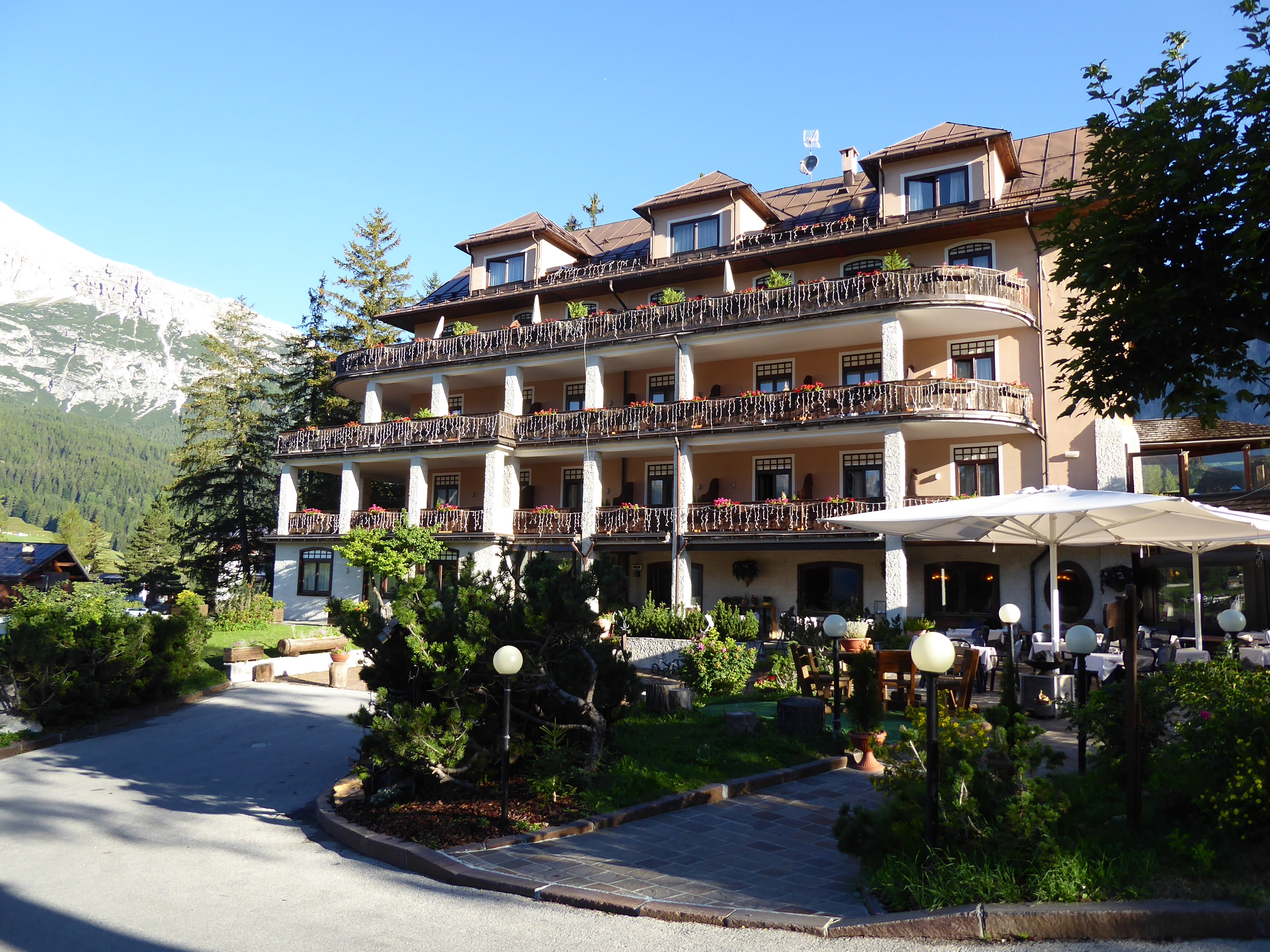
Fourtuantly John had booked us into the the very comfortable Villa Blu Hotel just on the outskirts of the town.  We made this our" base camp" for the first five nights.

The Hotel Villa Blu


This was John's first trip to the Dolomites and so we started on the relitively simple Via Del Guide on the Cinque Torri.  The approach is fast : You sit on a chair lift for about 10 minutes, then you walk to the foot of the route in about 15minutes.  Of course there is a price to pay in that there was the inevitable queue.  Luckly the two teams in front of us set of the wrong way and we were able to get in front and enjoy a good climb in beautiful weather and sublime scenary.  Once we were on the top of the tower we made three rappels and then went to look around the old 1st world war fortifications.


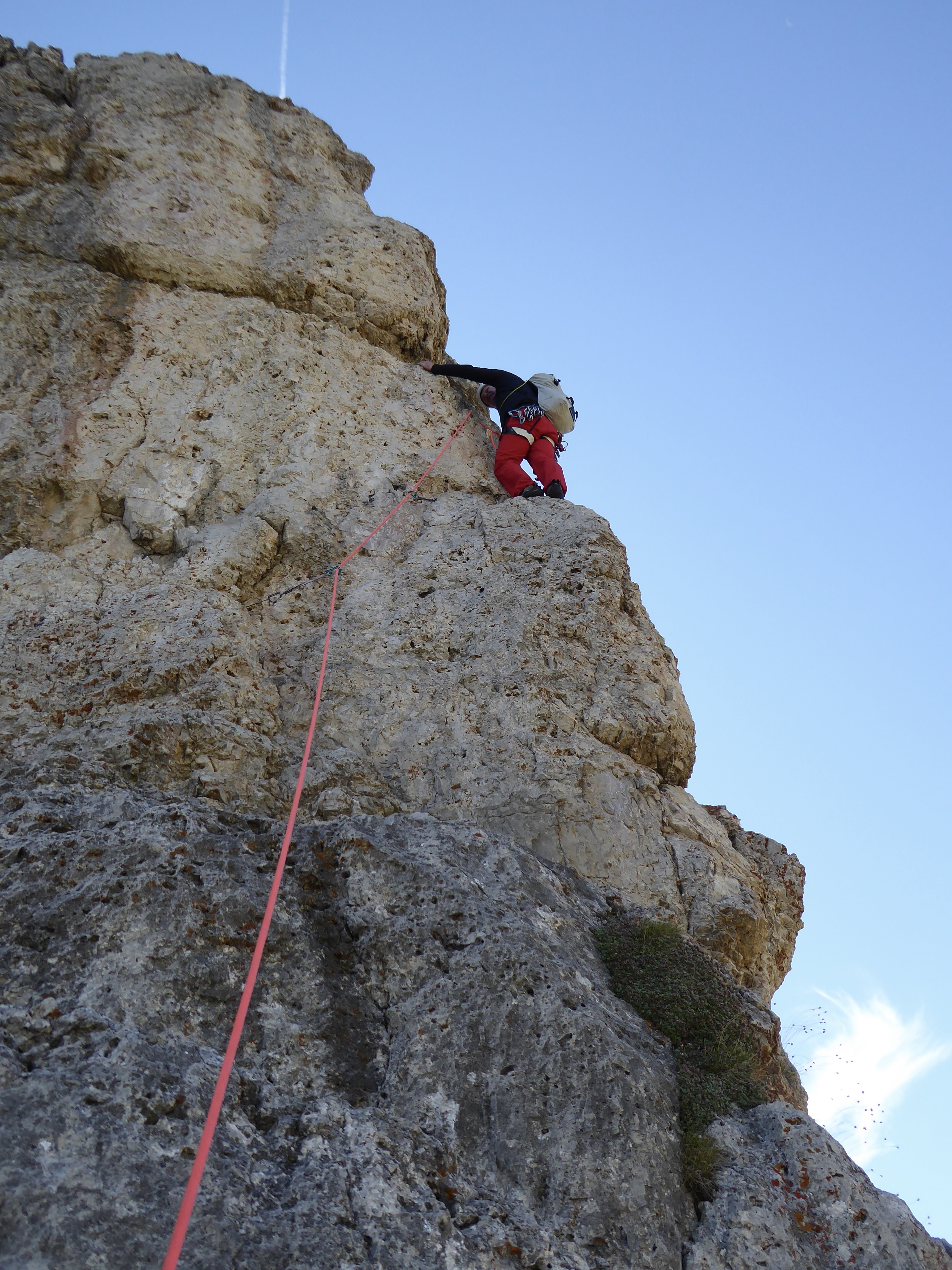
Climber on 1st pitch of Via del Guide

Having enjoyed a good introduction to Dolomitic climbing , the next day we headed for another of the Dolomites classics: The Comici Route on the South ridge of the Falzargo Towers.

The Falzargo Tower

Un ravelling the ropes at the start.


looking up the penultimate pitch.
Although it could have been very busy we only shared the climb with two other climbers, Erica and Unberto.  They proved to be  good company and we all met up for a celebratory beer afterwards.

During the next two days we had a bit of a weather hiatus.  We decided to sit it out, because the weather forecast going forward, promised to be marvellous.  We had a "council of war" and carved out a plan for our remaining time.  The plan worked perfectly. This is what we did:

On our next day of climbing we drove to lake Misurina, from where we walked up the beautiful valley to the foot of the Tour Wundt. The climb its self was another Dolomites classic with chimneys and cracks.
South Face of Tour Wundt


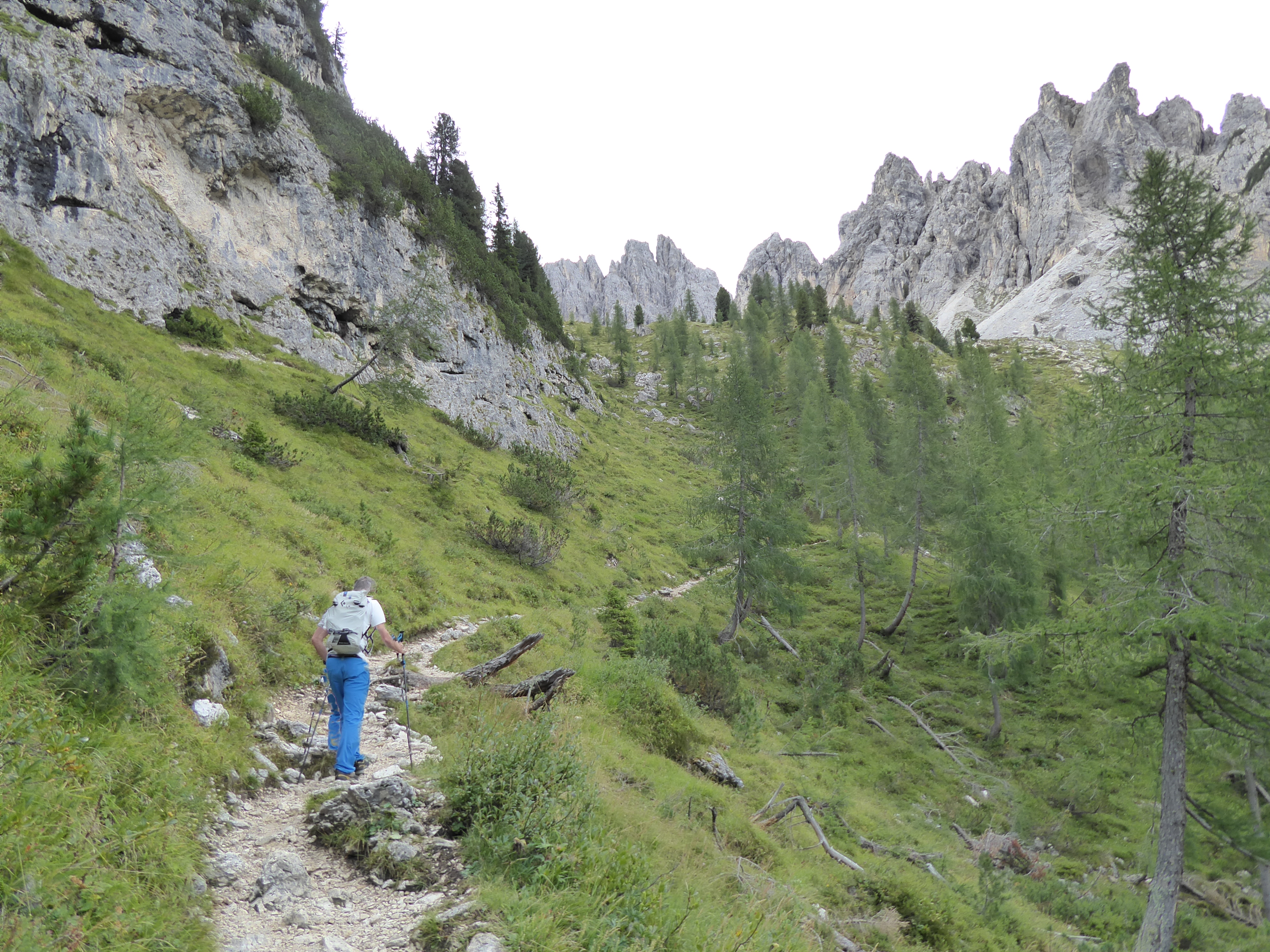
Beautiful approach walk to Tour Wundt

one of the chimney pitches.
The summit with the Tri Cima in the distance.

The Tour Wundt is one of those climbs where there is plenty to go wrong if you don't keep on top of it.  For example the rock is far from perfect and the protection is well spaced, plus the descent from the summit is complicated.  Yet all went perfectly for us.

The climb the next day a little less so.  Our friend of the other day, Unberto, had recommended a suposedly simple climb called  Del Tetto.

The crux. A hard move left into the sunshine


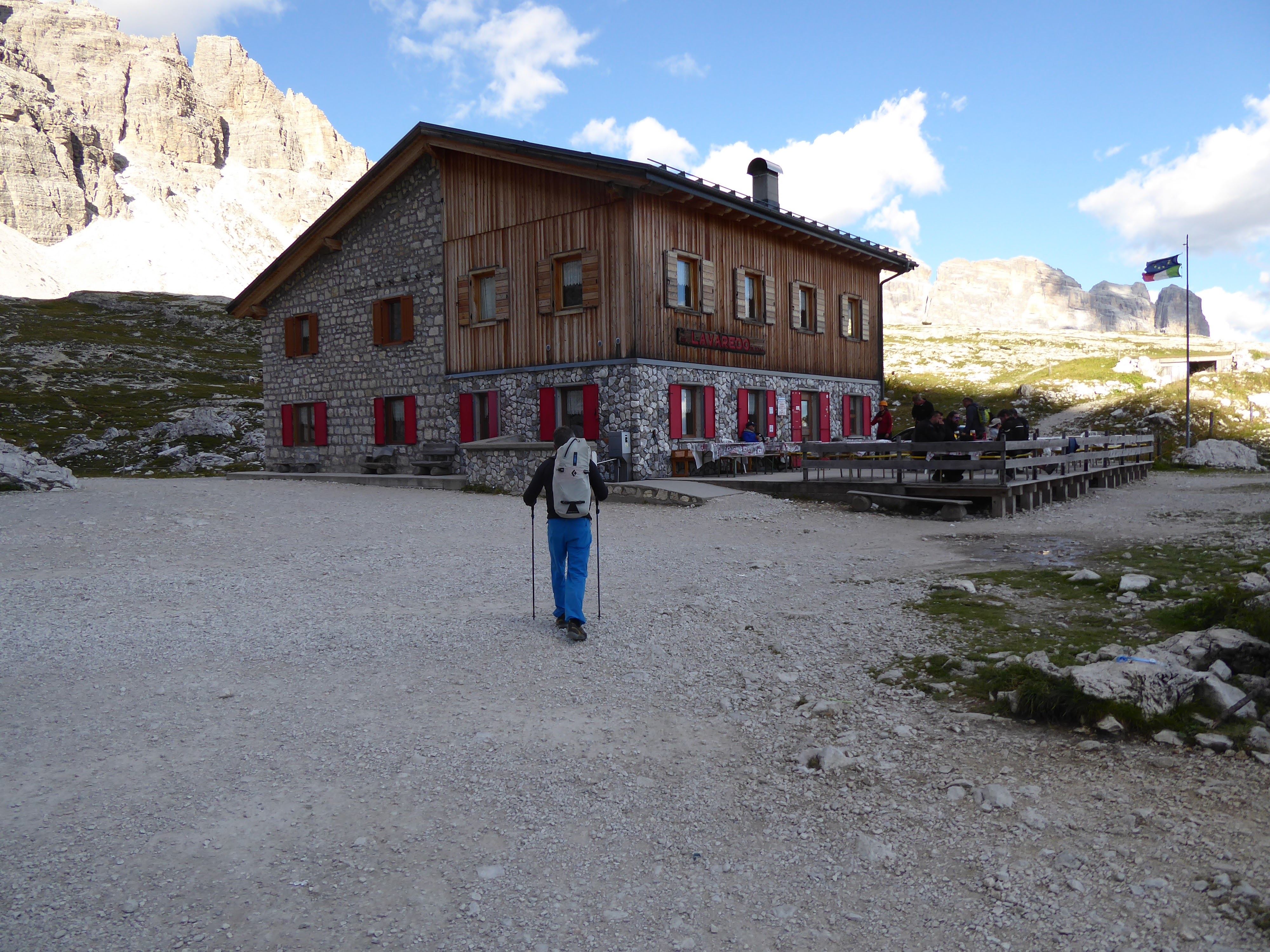
This is situated at the top of the Falzargo pass.  Somthing obviously got lost in translation because it was easy apart from a three meter section which was desperate.  This coupled with an inacurate route description made for a longer day than we wanted, especially because of instead of returning to our delightful hotel, we were booked into the Refugio Lavarado.

Anyway we made it. 
Refugio Lavarado
We were now in probably the most well known part of the Dolomites the Tri Cima Lavarado.  Our goal was to climb the Cima Grande via the Dibona North East Ridge.

Breakfast was a 6.00am and we were away soon after.  Twenty minutes later we turned a corner and were confronted by our objective:
Tri Cima

Our route followed the arĂȘte on the middle tower.

A further half hour and we were at the start of the route.  There was another pair Ditta and Lucas.  Ditta was an Austrian Aspriant Guide and Lucas was his friend and
 "dummy" client.
To begin with the rock was steep and cold.  It took a long time before we were in the sun.

John emerging out of the shadow.


Me on one of the many belays.

This was a truely magnificient climb, we lost count of how many pitches we did, but by the time we reached the finish we felt "well climbed."  
There was just the significant  matter of getting down.  This involves reversing the normal route by making a series of rappells interspersed with lots of down climbing. 
starting the long descent .


 Eventually the route splits and it is now possible to follow a new descent line that takes four 30 meter rapells which rather conviently dumps you about a 20 minute walk from the car park.  All in all we were on the go for about 10 hours.  Defiantly the crowning momment of our Dolomite trip.
The new descent drops you above the car park


We spent the night at the top of the Pordoi Pass in the Hotel Savoia. Tired but content , especially after a good meal and plenty of drinks.
The following morning we drove around to the Sella Pass and by some good fortune managed to find a parking slot.  Even though it was only 8.30am the place was heaving.  Our goal was to be the First Sella Tower via the Steiger route.  
The Sella Towers


Finishing up the final pitch

John topping out on our final Dolomite tower.


The three Sella Towers seen from the road.


This was a fine way to finish off climbing in the Dolomites. We departed via the Val Gardena and spent the night in the beautiful town of Brixen where we stayed in the Hotel Goldenes Roessi which is bang slap in the middle of the marvellous old town.

For our final climb we drove towards the world famous climbing area of Arco and climbed the 10 pitch route Amazzonia.  This was a significant change of scene.  Not least because it was hot.  Frankly too hot and I was relieved when we finally topped out and found some shade.
view from the climb Amazzonia

John above the Vineyards


John contemplating his next move.
Still the actual climbing was superb, with a bolt every two or three meters which was very pleasnat after some of the heart stopping run outs of the Dolomites.

Our final night before driving back to Chamonix was in the Pace Hotel in the center of Arco.  Again a beautiful location in the heart of   lively  old town.

Friday, July 08, 2022

Different climbing around Chamonix.


Aguille Verte& Dru. [see final photo]


Finally after failing to leave Canada for two years and having cancelled two trips, Stephen Kellock made it to Chamonix albeit jet lagged and tired.

Day1 The best shake-down route in this situation [or any first day ] is the Via Cordia above La Flegere.  It is in a stunning position and gives a nod to acclimatisation.  For someone who has not climbed in a while it provides some thought provoking momments without being too daunting. Once it has been completed the descent is made by chair lift and so the knees are not given a thrashing.

Day 2, Started with a poor forecast which claimed it was going to rain all day.  We were keen to keep some momentum up and gain as much acclimatisation as possible .  We choose to drive up to the Barrage Emosson and walk up the Bel Oseau.  This proved to big a good choice, not only did were we treated to great views, we stayed dry.

Lac Emosson

Day 3 . The weather was good .  We headed up to make the traverse of the Aiguille Chrochue, one of my favourite routes of its grade.  It was quite busy but we managed to avoid the queues with some secret diversions. We even got to swim in lac Blanc afterwards [Well I did Stephen produced some unsatisfactory excuses.]

Stephen enjoying the wonderful climbing


Day 4.  We headed up the Sky-Way lift into the Italian side of the VallĂ©e Blanche and climbed the Aiguille Marbree.  The conditions were far from ideal, as there had been no overnight freeze and the glacier bordering on being treacherous .

Me on the summit of something.


Day 5 Clear skies over night meant there was a freeze, which was perfect for our crossing of the Vallee Blanche from the Aiguille du Midi to pointe Helbronner.


  We returned via the spectacular "Eggs."


Day 6 We changed the emphasis of our climbing from general alpine climbing to alpine rock climbing. Yet It rained hard over night and was slow to clear the next morning so we started a little later and climbed above La Flegere on a  multi-pitch rock climb called Athena.  It was hard because parts of it were still wet and there was a strong wind blowing.  


Day 7  We headed upto  the summit of Le  Brevent and climbed Mic est Mousse.

Stephen on the final pitch of Mic est Moussia


Day 8.  Stephen had never climbed a via ferratta and so we visited the one above Passey. 

Stephen being great

 
view from Via Ferratta looking towards Mt Blanc

Day 9.  Stephen enjoyed the via ferratta so much that he was keen to do another one and so we headed up La Flegere one last time and climbed the Evettes Via Ferrata.


Oil painting of Aiguille Verte by Chris Boulton taken from picture at the top of this blog post.

Thursday, June 23, 2022

Mini Italian trip.


Reuben on final pitch of Athena.


 I had four very interesting days climbing  with Reuben Berg.  Three of them in Italy and our first day in Chamonix.

On our first day we took the cable car from La Flegere and walked over to climb a route called Athena.  Despite it being a Sunday and not a cloud in the sky, we were the only people on the crag. Why ? It was impossible to say, but we weren't complaining. The only thing we did complain about was the heat.  The alps is experiencing another unwelcome "canicule."

On the Monday we headed off on our mini Italian trip, driving through Switzerland and over col de Gd St Bernard and climbing on a crag called the "Petit Cervin" [Little Matterhorn]. We climbed the route" La Charlie". The first ascent was made by the brilliant Chamonix climber Terry Renault and Raymond Gay - a monk at the Monastery.  It is a wonderful 8 pitch climb in an equally wonderful setting.  The only downside was the noise from the wankers who ride their obnoxiously noisy motor bikes up and down the road.

Le Petit Cervin.


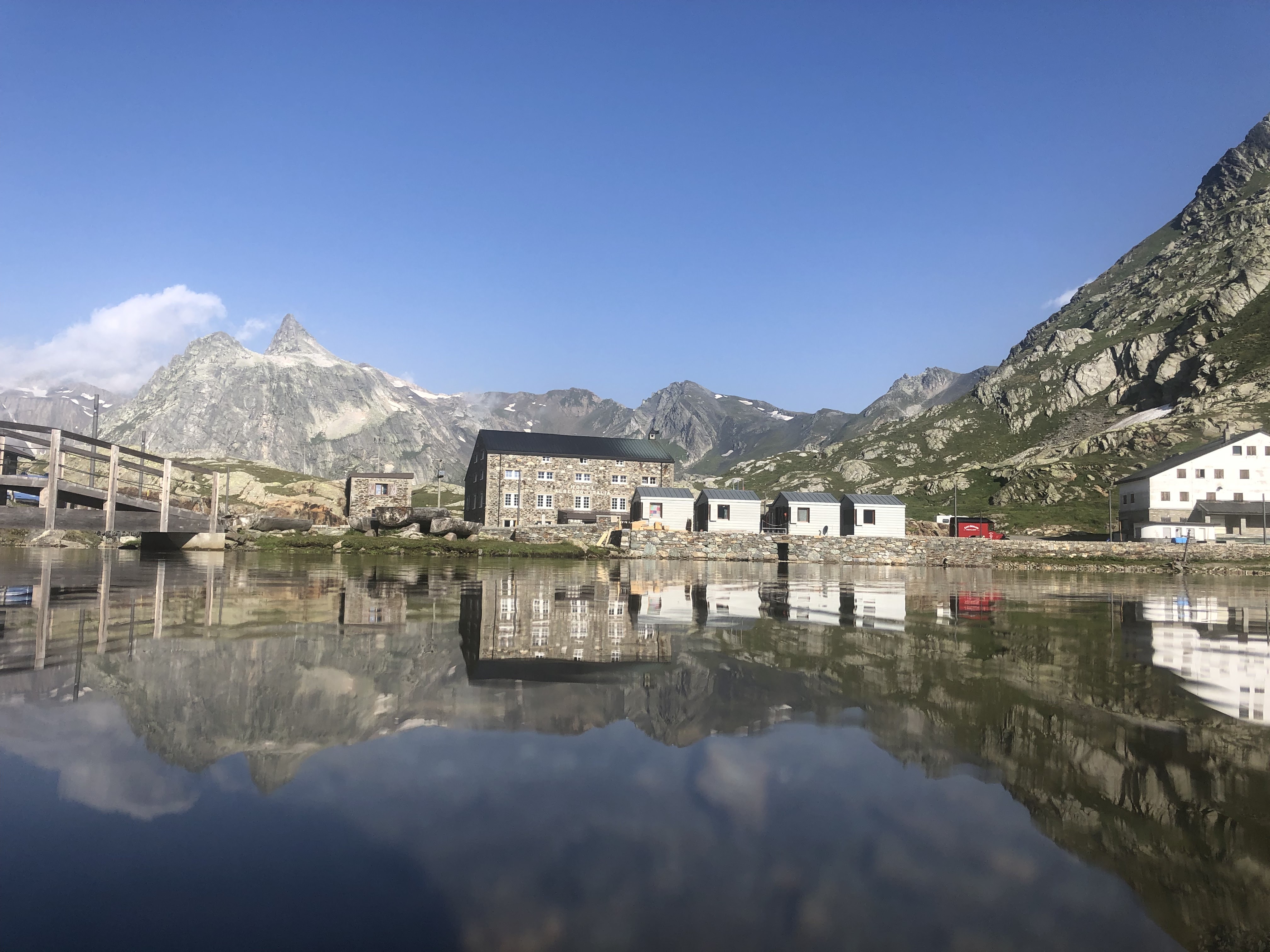
After climbing stayed in the Hotel Albergo Italia which is situated at the Col du Gd St Bernard just over the border.  It is an incredible hotel.  It also has the advantage of being at 2470 meters which makes it a good place to acclimatise.

Hotel Albergo Italia


After an excellent breakfast 

beautifully presented breakfast.


We had a leisurely drive down in the direction of  Aosta  before turning off the road and heading up Vallpelline valley towards the village of Dzovennoz. From here the plan was to head up to the Refugio  Crete Seche.  

We were given dispensation to drive up the track which cut a good hour and half off the walk which was a relief in the oppresive heat.

Refugio Crete Seche

The Refugio Crete Seche is wonderfully positioned, with a delightfully welcoming guardian.  We were the only guests. 

Breakfast was at 5.00hrs and we were away at 6.00hrs. There was no need for head torches because we were setting out on mid summers day.  Our goal was the traverse of the Crete Seche ridge which runs directly along the Swiss /Italian border.

These Ibex were only signs of life we saw all day 

We walked up the long wild valley until we arrived at the col de Crete Seche.  This took an hour and a half.  We stopped to eat and put the rope on before setting off up the ridge.  There were a few spots of rain and some ominous black clouds, but we judged we would be okay.  We arrived on the summit of the Dent d'Oyace an hour and a half later, still dry.

Reuben on the arete.

A further picnic stop and a drink  it was then  back down to the Refugio, a quick Cappuccino,  down to the car and a return to Chamonix via the Mt Blanc tunnel.


Tuesday, June 21, 2022

Training the next generation


Dent du Geant seen from the Aiguille Marbree


I kicked off the summer season by working on the famous Jonathan Conville Memorial Trust mountaineering courses. https://www.jcmt.org.uk.

Their very good website sets out their aims :

The Jonathan Conville Memorial Trust ensures young people from all walks of life, regardless of opportunity, experience the challenges and rewards of mountaineering. Through building knowledge, confidence, and ability, we train young people to safely reach their most ambitious mountaineering goals, certain that personal growth in the mountains solidifies into every other aspect of life.


The courses are aimed at young mountaineers who are coming to climb in the alps for the first time. With the intention of them  climbing on their  own afterwards. [Ie without Guides] The aim of the course  is to make sure they are able to go home alive at the end of their adventure.  The courses aim to give some key skills, but also impart as much advise as possible, on everything from which are the best weather forecast apps, to what to carry in an alpine rucksack and perhaps more impotantly what not to carry.


My three students were Janine Alexander, Alex Everest  and Ben Taylor.  After meeting on the Chossalet campsite in Argentiere [where all the alpine courses have been based since their inception in 1979] We headed up Le Brevent.  We started by looking at how to move safely on steep snow slopes and then moved onto looking at how to alpine climb using the rope safely and quickly.  We also looked at how to escape from situations which we might have " overcooked."

Ben Taylor using a direct belay.


On the second day we drove through the Mt Blanc tunnel and took the Sky Way cable car.  From here we climbed the Aiguille Marbree.  We finished the afternoon looking at crevasse rescue scenarios and setting up pulley systems.  The key take home point is that firstly it is better not to fall into a crevasse by employing best practise techniques and secondly it is virtually impossible to safely hoist some one out of a crevasse if you are the sole person left on the surface.  

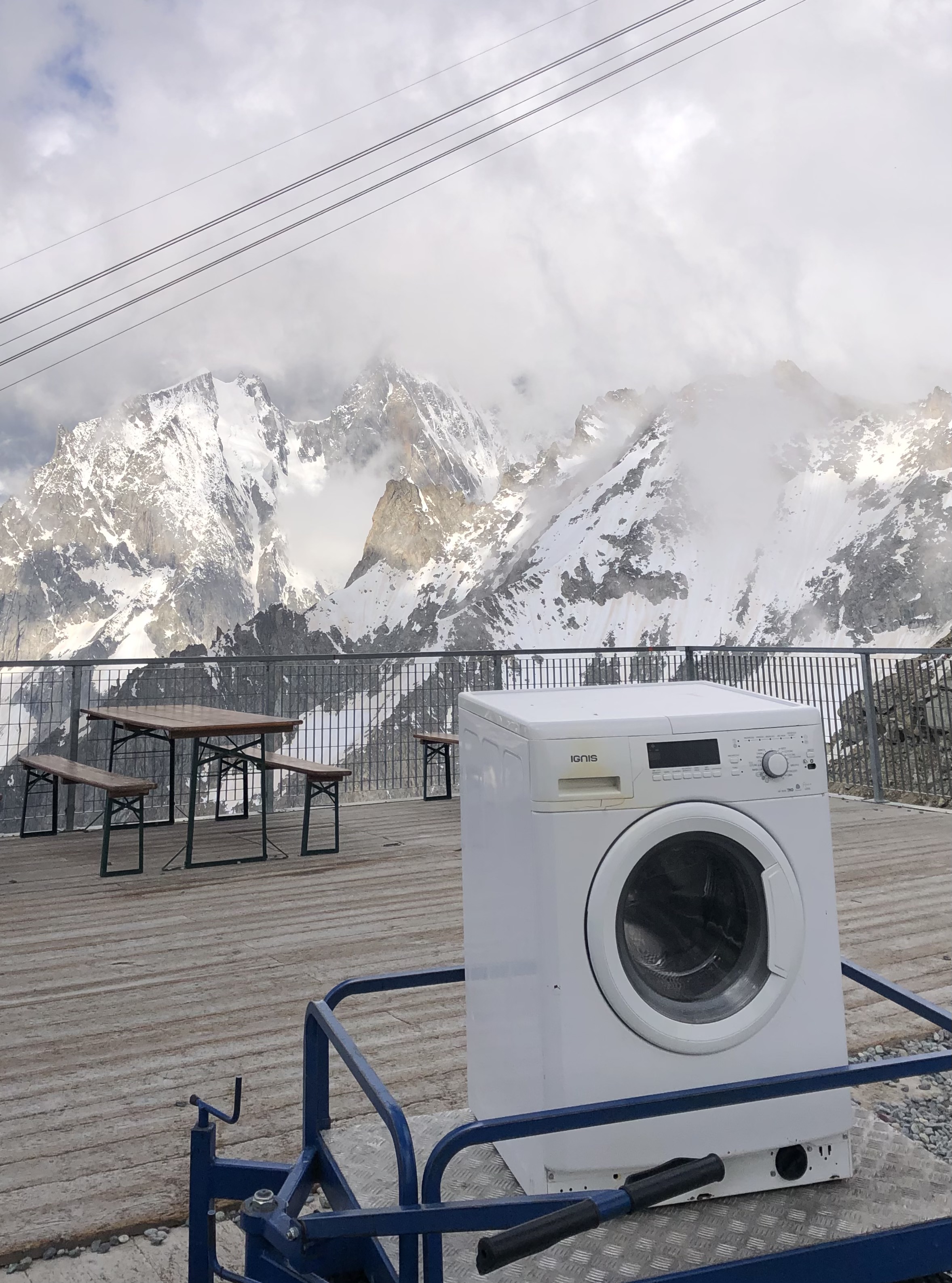
A washing machine which would make an ideal crevasse rescue anchor

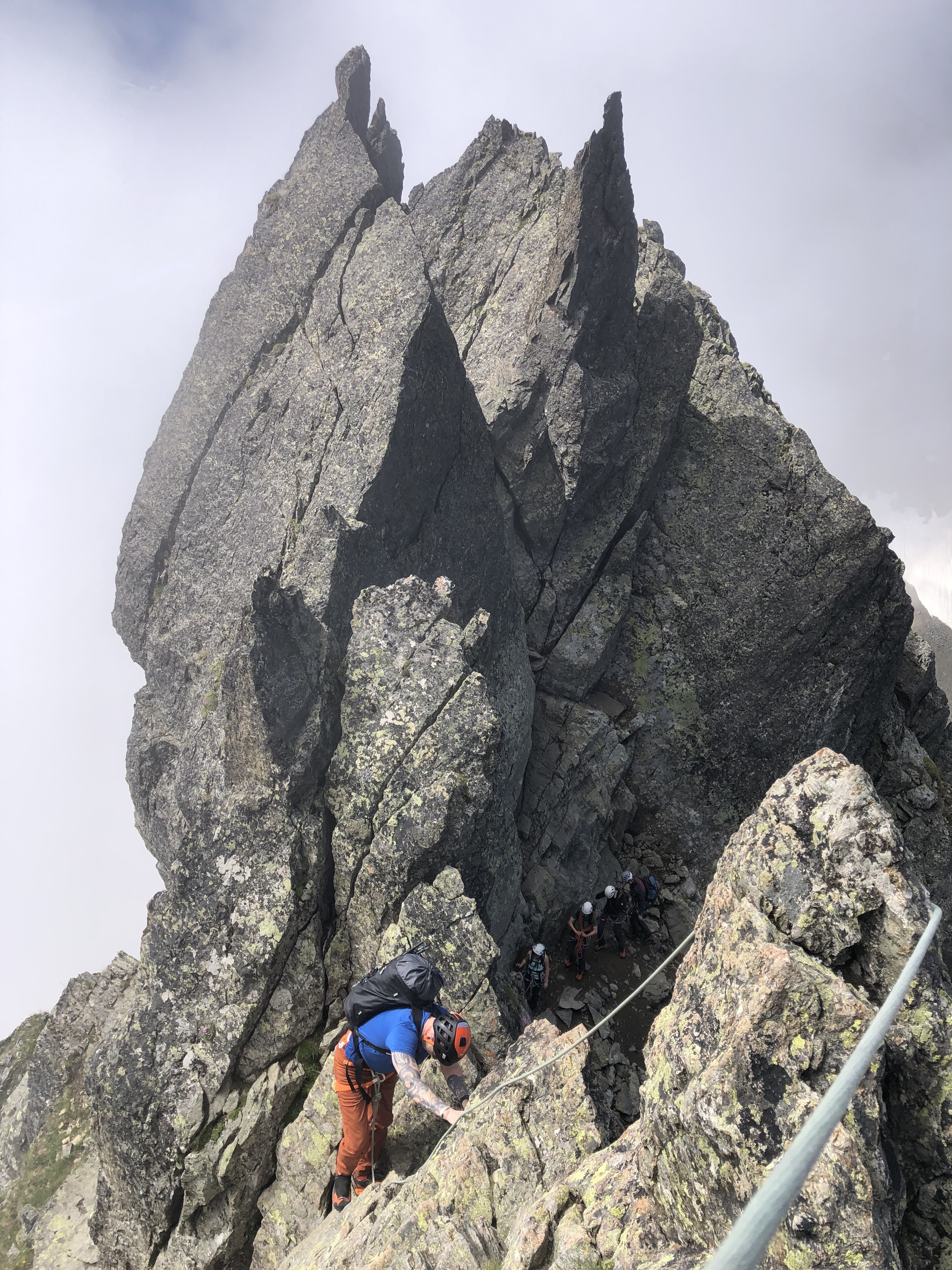
Jane Alexander on summit of Aiguille Marbree.


Teaching crevasses rescue generally means you know enough to be dangerous...

On our third day we negotiated the enormous queues at the Aiguille du Midi [by having pre booked our cabin slots ] and went and climbed Point Lachenal.  This gave us plenty of opportunity to learn the fundamentals of cramponing.  After all if you dont know how to climb on crampons the rest of your alpine climbing career is going to be somewhat compromised.


This was also a good place to introduce the notion of the alpine walking pace.  Ie very slow and steady.  The team being in their very early twenties were sceptical about the need to go so slowly, but by the time they had walked back up the Midi ridge in sweltering heat and had overtaken every other team, they were a littel more convinced.