Showing posts with label alpine. Show all posts

Thursday, September 03, 2020

The Chamonix Classic Climbs .

 After our ascent of the Arete de Saille, we both felt "well climbed".  It  was a big day and we decided we needed a simpler day.  Yet when we met in the morning the rain was there to greet us and so like so often a another idea  needed  to be conjured up,  

John for all his previous mountaineering experience had never tried a Via Ferratta. Like many true mountaineers he was a bit ambivalent about them, but poor weather and limited options he concluded that this was a good as time as ever to commence.

We choose the Via Ferrtta in Le Fayet,  behind the Thermal Baths . It was recently built and it has a reputation for trapping the unprepared.  In fact when it was first built it was ill conceived and resulted in lots of rescues from people with failing arms.

Since then it has been reconfigured and split into three sections with the option to quit at three different points.

We set off up the first and supposedly easiest section and although it had stopped raining it  was oppressively  humid and it felt like some practical- joker had been just ahead of us coating the ladders with soap.    Yet John seemed to be powering his way up and after the spectacular Himalayan-Bridge there was the option to bail.  John was having non of it , he was keen to try the second part.  This starts  sedately and then becomes significantly harder [read over hanging ladders and bold traverses.]. 

I have, over quite a few years done many Via Ferrtta's and this was  the most difficult.  Spectacularly beautiful , but defiantly not for the non committed debutant.  We choose to retire for lunch at the end of the second section and leave the finale for another day.  Lunch, as it happened, was very competent in the grounds of the Thermal Park.

This Via Feratta is definitely not for the faint -hearted.

Like all our big two week trips together we like to work towards  an "End Game" - a mountain  of significance that we set as a potential goal.  This year I had identified the Weisshorn as that goal.  Yet when I went to make the reservation in the Weisshorn Hutte   it had just  closed for a rebuild.  Plan B. We looked at the possibility of climbing the Grande Casse the highest mountain in the Vanoise.  Yet the Refuge was having some sort of organisational crisis , not unrelated to Covid.  

Then we realised Chamonix was unusually quiet , the weather forecast was perfect and there were plenty of the classic climbs which John had so far not done.  We  had the  opportunity to climb them without being swarmed all over.

Our first of the classic Chamonix climbs was the traverse of the Clocher-Clochotons with its  iconic Tyrollean Traverse . First done in 1912 and it hasn't lost any of its magic.

The Tyrollean Traverse
The Iconic Tyrollean traverse.


The next day we climbed the traverse of the Aiguille Crochue - the weather forecast was indifferent , very misty and atmospheric - far too atmospheric for all continental parties and unsurprisingly the only other two groups were British.
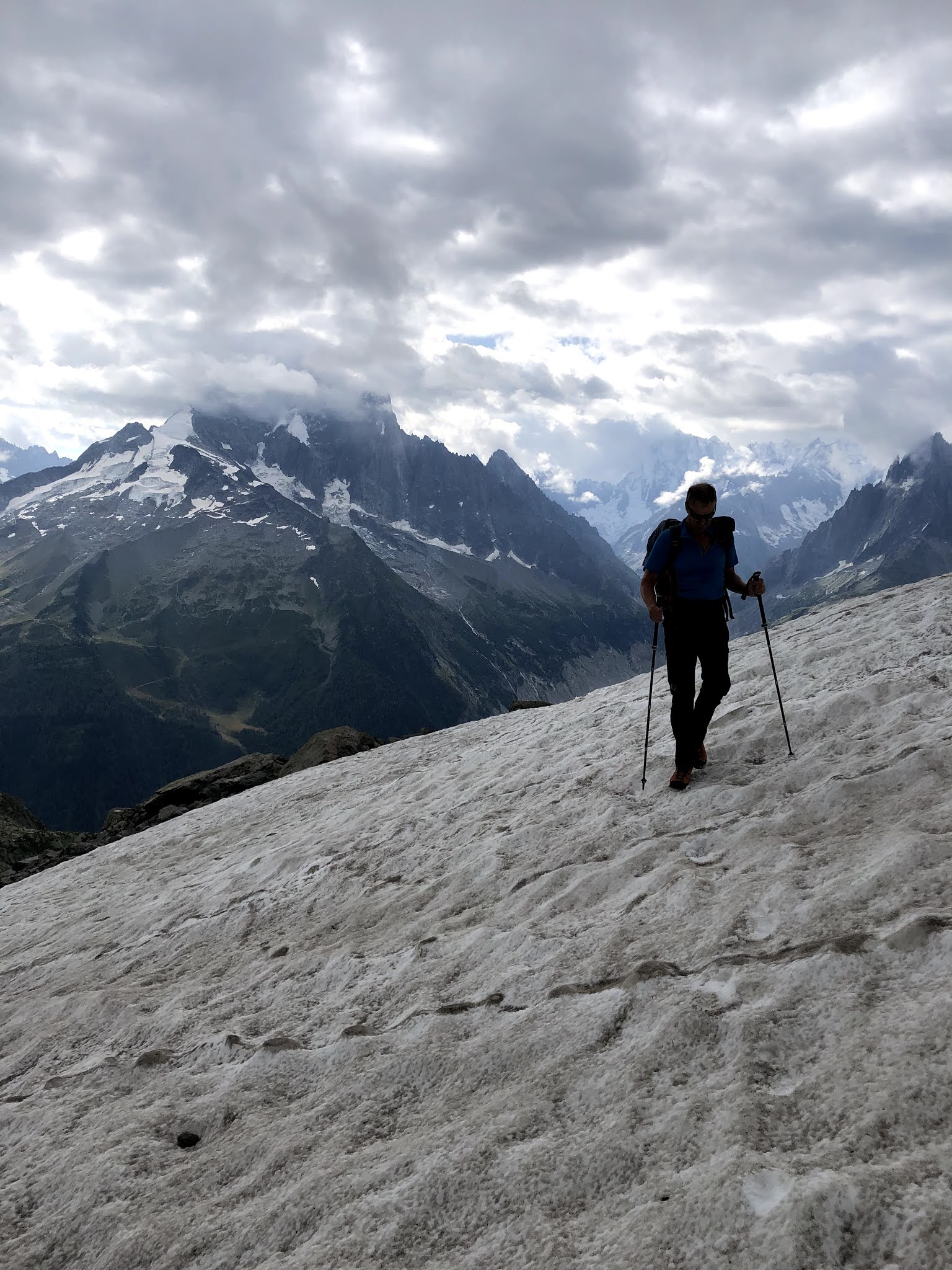
Approaching the start of the climb to the ridge


Magnificent ridge scrambling
John on the ridge

John & I with photo taken by fellow BMG Guide Stuart Macdonald
John & I . photo taken by fellow BMG Guide Stuart Macdonald.

Still managed  a swim in Lac Blanc on the way down.

Swim in the Lac Blanc


Next day was our chance to go for the Cosmique Arête .  A climb that has become so popular that frankly it  is frequently  untenable because of the bottle-necks plus it has suffered some significant rock fall which made parts of the route dangerous.  Yet with Chamonix quiet this was our chance to climb what is undistubitably  one of the finest climbs of its type and grade in the Alps and probably the world.

Crux pitch not as hard as it looks.


Yet  confidence was a little dented because as we travelled up in the Cable car, I met my good friend Eric Cantelle who is the chief electrician for the Aiguille du Midi. It's his job to keep it running when  the weather gets bad.  He has access to weather forecasts that us mortals don't have, because knowing what the weather is going to do is critically important to keeping the biggest generator of cash in France functioning.  Eric said " You need to be quick the forecast for the afternoon is bad". 

The Cosmiques Arete.

We were not so much quick, as efficient, with only a couple of other parties we had a wonderful experience and what's more the bad weather never materialised .


John in the Exit Cracks


Next was another Chamonix classic : The papillons Arete .  We were away early and we had the whole route to ourselves again.  It was just perfect.  

First pitch. Brutal for a grade 4 pitch

Stunning climbing

Positions are breath taking .


Having said that it is a classic Chamonix grant climb with lots of skin shredding crack climbing rock.  We needed something a little less aggressive for the next day and we choose the Peroux route on the East Face of the L'Index.  Again immaculate climbing which we had to our selves , well at least until we reached the ridge and joined the normal route , where chaos ensued .  It is, I'm afraid, one of those climbs that no matter how bad you are at climbing you can be certain there is some one worse than you.  It was a jumble of ropes knots and people not sure how or where to rappel from.  Fortunately for John and `I we had two 60 meter ropes so we could by pass everyone and arrived directly at the foot of the route from where we went for a late lunch at the Castel Restaurant  in Les Praz.

East Face of L'Index


Our final day together was our hardest  rock climb of the trip.  The beautiful Acqua-Concert on the Aiguille du Van with the jaw dropping back drop of the Lac du Emosson.  This is a modern bolted route on perfect rock. 

The turquoise Lac Emmossen give the perfect back drop
Turquoise backdrop of Lac Emosson


 The climb finishes on the summit and then it's a simple scramble back down to the scene of the giant beer tankards.


Big routes need big beers
Big routes require big beers.


Friday, August 28, 2020

Cabane Covid proofed...

A very good view.

 Finally, finally, after quite a few false starts the mountain guiding season started for me.  A lot of things needed to come together, not least John Young's super human determination to actually get here.

John and I had been due earlier in the year,  to ski together , yet it wasn't Covid that stopped this but a broken arm.  Although it had healed well, John had had no opportunity to "road test' it.

We decided that we should do this as conservatively as we could and chose to climb the Pic Janvier route at Flegere.  This delightful ridge runs parallel with the Index chair lift, meaning that once you have finished you merely stroll over to the chair and ride it down.   It would be the ideal first ever route in the alps because,  if you were to make a complete hash of it, or get  or lost, fall off it, or take hours and hours, then you would know not to progress with bigger alpine adventures like any of the peaks behind the photo.  

Pic Janvier our warm up day.


Anyway I think that in almost 30 years of knowing John it is the easiest route we have ever climbed together, yet it is still excellent and it served its purpose- John's arm was just fine.

So we ratcheted up our ambitions stratospherically  and headed off to climb the Arete du Saille on the Grand Muveran.  We walked up to the delightful Cabane du Rambert to experience our first Covid Cabane education.   This involved giant pieces of perspex dividing the tables. 

strange times  Covid  screens


Plus door size sheets of wood hung  horizontally from the ceiling  to create a sort of labyrinth.  Then we were informed that there would be two dinner services so that everyone could be more socially distanced.  

With a little imagination you could see how the Swiss Alpine Club had conjured up such a plan.  But as far as the sleeping arrangements- then  there was no plan.  Everyone was stuffed in the same dormitory as if Covid was not a problem up stairs.

The Cabanne Rambert doesn't get many climbers - mainly walkers and so there is no early breakfast .  The guardian said she would leave breakfast out for us.  We settled down in a couple of deck chairs on the sunny terrace and supped several beers each.  Then, I thought I  recognised someone working in the kitchen but dismissed it as unlikely to be who I thought it was.  But we caught each others eye and he recognised me .  It was Vincent one of the original guardians of the Gouter Refuge.  He and his great friend Guy Bochatet had run the Gouter incredibly well through some unbelievably difficult times.  They were absolute legends.  Vincent and Guy retired from the Gouter 19 years ago. The Gouter carried on but it was was never the same again. Guy's father had been the Gouter guardian before him.  Legend has it that Guy was actually born on the train coming down from the Nid Aigle because his mother had gone into labour before she could reach the hospital in Sallanches.  Long before helicopters were common place.

Vincent started working at the Gouter at roughly the same time I qualified as a Guide.  Like many Guides starting out I used to climb Mt Blanc once or twice a week  and Vincent and I became good friends. We had been involved in some dramatic rescues together too.  He was also wonderfully helpful and kind when I guided Don Planner to the summit of Mt Blanc.  Don was the first blind man to reach the summit.  When he left we lost contact and so to meet him unexpectedly in another Refuge in another country was just fantastic and frankly quite emotional because these had been special time in our lives.

Vincent insisted that he should get up to give us breakfast, after all,  a man who for 17 years got up every night  at 1.30 am to serve breakfast to over 200 people this was not a challenge.

John and I struggled down to breakfast at the comparatively civilised time of 5.00am.  Vincent had laid the breakfast table in the guardians private quarters.  Everything was perfect and he said rather nostalgically " It just like old times?" which of course it wasn't, not least because we were minus about 200 other fighting pushing wannabes.

We left the Cabane  just before dawn.The approach to the Arete de Saille starts by walking down hill for rather longer than you would want.  It then involves walking back up a hillside on a vague path for a lot longer than anyone would want.  

Locating the start of the route is not simple.  One of the reasons is that the route was, until 2016, a well bolted sports-route .  Then some "Eco-Guides" decided to "desequippée" the climb.  What this means is that they removed most of the bolts and cut the main belay stations.  The idea was to return it to a feeling of a  more traditional big mountain rock climb.   Imagine if they decided to do the same thing on the Matterhorn?

This is all very well as long as you know this, otherwise you can turn up equipped entirely with quick- draws with nothing to clip them into. Precisely  what happened to me last year and this led to a very scary fraught ascent well out side my comfort zone.  

This time I came with a traditional rack of protection but it was hard to remember exactly where the start was without seeing a big shiny belay chain which is code for start here and go exactly there and then  there and so on and so forth.

What's more the start is not on the most inviting rock.  It is very loose and serious.  Yet once properly established on the route it all starts to flow beautifully.

John on one of the many draw dropping pitches.

Then came the stunning stand out pitch . followed by the last pitch which has an awkward rather lung busting move to actually reach the end of the sustained rock climbing.

The stunning atmospheric penultimate pitch 

John belaying while I climb the awkward last pitch


Yet like all true big alpine rock climbs just when you think its over it continues to lay down various challenges.  After several pitches of moving together you are confronted by a steep difficult wall which is as hard as anything on the route.  Then there was the challenge of finding the best line over some very complicated ridges.  Finally we made the summit and the beautiful views all around.  Lake Geneva to the north and all the Swiss giant mountains to the south.

John on summit 


The descent from the summit is down the normal route.  It must be said that its not the most interesting route- lots of loose rock and a lot of it close up resembles a quarry.  We saw no one all day which again just adds to the wilderness experience.

Nevertheless it took just over an hour back at the Cabane , say our good byes to Vincent and the promise we would not wait another 19 years before we saw each other again

All that was left was to walk down, but not before getting a traditional drenching in an afternoon thunderstorm.

Sunset on the Arete de Saille

And this was only day three of our time together . More to follow.


Wednesday, May 27, 2020

Seven Climbs by Charles Sherwood

To mark the publication of his new book Charles Sherwood has written a short piece on 

How to Choose a Mountain Guide


I first met Mark Seaton in 1993.  We have climbed together, often two or three times a year, ever since – in ski boots, in mountaineering boots and crampons, and in rock shoes – from the Alps to Africa.  We have shared some unforgettable experiences from the Old Man of Hoy and a traverse of the Matterhorn to the North Face of the Eiger and a traverse of Mt. Kenya.


Mark has unquestionably been my ‘chief guide’ over those years, but I have used others too, especially in more distant parts.  So, how do you choose a guide?  I am assuming things like basic competence, evidenced by qualifications and experience.  But, what other factors should you take into account?


First, I would suggest, temperament.  When we met, Mark was a young guide with considerable ambition.  But that ambition included becoming an old guide.  With a lovely wife and three daughters, Mark had no plans to get killed – a fate that sadly befalls all too many guides.  I, on the other hand, have always been more from the ‘go for it, come what may’ school of outdoor adventure.  I too, however, have a wife (equally lovely) and three children and I did recognise that in a guide I needed an element of prudent caution.


Second, personality.  A climbing partnership is an intimate one.  The new fashion of ‘social distancing’ is not easy on a portaledge, or at a tight bivouac, or trapped in a refuge for days on end.  It is important you like each other!  In Mark’s case, his devotion to client service extends even to bedtime stories.  He is the author after all of the children’s series, Mark the Mountain Guide.


Third, type of climbing.  This is more relevant in North America, where guides tend to be much more specialised: backcountry skiing versus ice climbing versus rock climbing.  In Europe there is more of a tradition of multiple competence.  Nonetheless, even there, you want to be sure that you and your guide enjoy broadly the same kind of climbing.  If one of you wants to go cragging at the side of the road and the other is hell-bent on the North Face of the Aiguille Blanche, then it is not going to work.


Mark Seaton Traverse of the Gods NF Eiger photo Sherwood


Finally, there is an important element of geography in all this: do you go for a truly local guide or what I might call an expedition guide, i.e. a guide who climbs all over a region like the Alps and perhaps even further afield?  The local guide has attractions.  There is the cultural affinity and, of course, you will never get lost.  But there are downsides.  The local guide is unlikely to be excited about a route he or she is climbing for the fiftieth time.  This is often cited as a problem with those Zermatt guides that focus almost exclusively on the Matterhorn.  Some, at least, are rather disengaged, choosing to eat, sleep and socialise separately from their clients.  The alternative is to tie up with a guide who is as keen as you to explore new climbs and new countries.  This means getting lost – I guarantee it – but it also brings a shared excitement and even a shared sense of responsibility.  You are a team trying to crack this problem together.  Most of the more ambitious climbs that I have done with Mark have been of this kind: climbs such as the Nant Blanc Face on the Verte in France, the Comicci Route on the North Face of the Cima Grande in Italy, the Biancagrat on Piz Bernina in Switzerland, and the Pallavicini Couloir on the Grossglockner in Austria.  These routes have been as new to him as they were to me.  Somehow that makes for a different and rather more fraternal experience.  It is the kind of experience that turns a guide into a lifelong friend.


Be wary though, because this climbing thing comes with a health warning: it can prove addictive.  It was as I descended from the Eiger with Mark after four extraordinary days on the mountain that I set my heart on a project that was to take me a further decade: to find an Eiger on each continent, in short the finest seven climbs in the world.  This challenge would take me from the Alps on to the Himalaya, Yosemite, the Andes, Kenya, New Zealand and South Georgia.  It is described in my book, Seven Climbs.  It can be bought by clicking on the Amazon link of recommended  books at the side of this blog.

Charles Sherwood
C Sherwood in the White Spider. NF Eiger.


Thursday, September 25, 2008

Patagonia blog features Mark the Mountain Guide


Just a head of the US release of the book Patagonia have been kind enough to review the book.

Sunday, August 31, 2008

Aiguille de Peuterey Blanche


Charles Sherwood and I topped off a fine weeks climbing by climbing the north face of the Aiguille de Peuterey Blanche, the most difficult 4000er in the Alps.

We began by bivying below Col Moore, then departing at 3.am. We finished by topping out on Mont Blanc then descending via the Gouter Hut.

See photos.